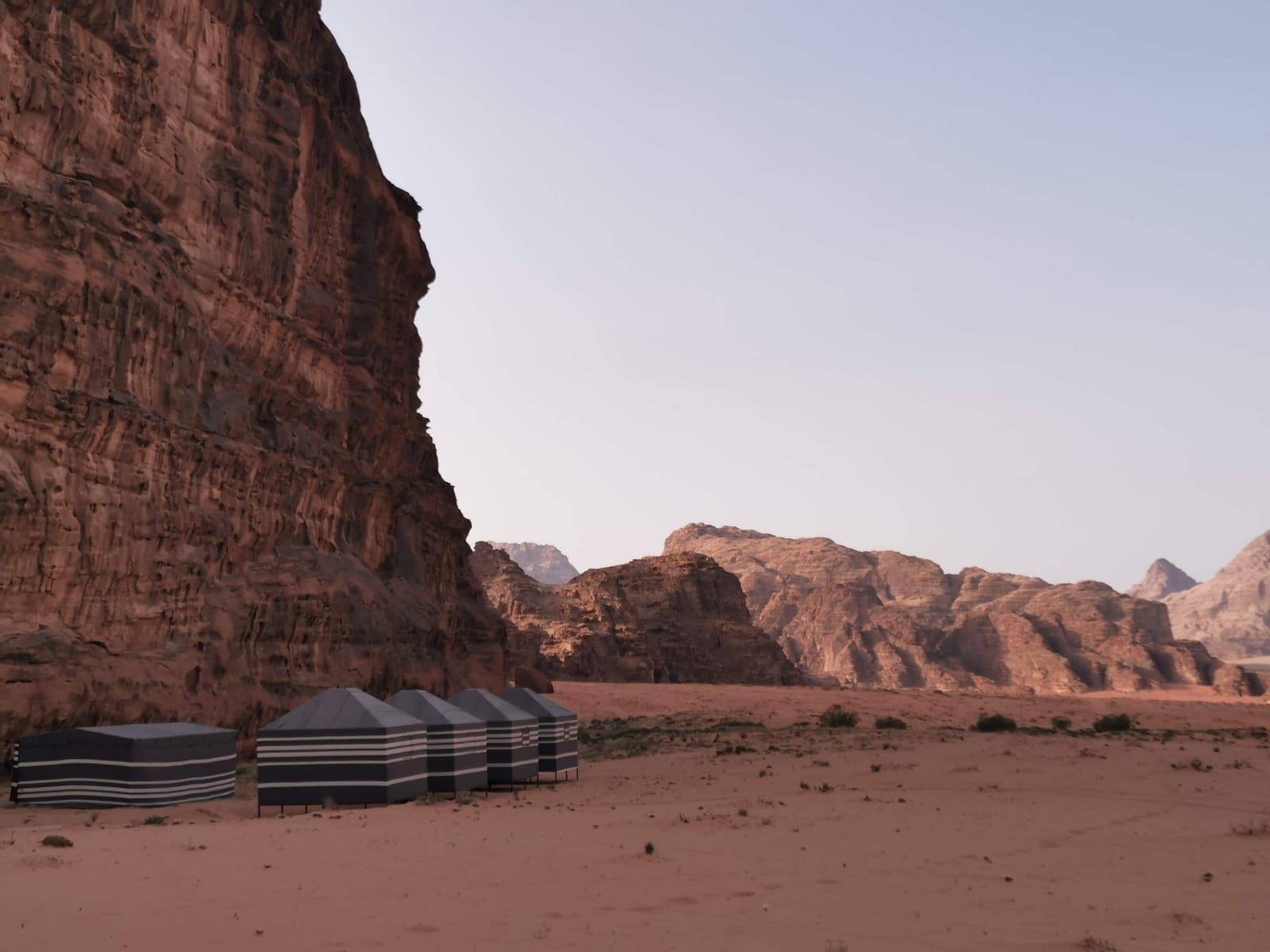
NightsoulWadi Rum Camp
Thirty places

Thirty places

A field guide to the soul of Wadi Rum

Every tour we run touches some of these. Together, they are the desert — its canyons, bridges, peaks, dunes and the silent inscriptions of those who came before. Hover or tap any site for details.

01 / 07

Canyons

05 sites
Canyon

Khazali Canyon

One of the most famous and most visited sites in Wadi Rum. The canyon begins as a narrow crack filled with petroglyphs and inscriptions at different heights — camels, horses, mountain goats, ostriches, people, pairs of feet, and writings dating back to pre-Islamic and Thamudic times. Handmade water pools sit deeper inside; the higher section requires a steep, slippery climb usually omitted from standard tours.

Canyon≈ 45 min

Abu Khashaba Canyon

A stunning canyon of red and yellow sand with an hourglass shape and a narrow middle that requires light scrambling. Surprisingly green thanks to desert bushes and trees. The walls are sculpted by wind and rain into shapes resembling animals and faces.

Canyon1.5 – 2 h

Barrah Canyon

A 5-kilometre canyon dividing the Barrah Massif. Sandy stretches, lush vegetation, dunes flanked by colourful cliffs and rock formations. Suited to all experience levels.

Canyon≈ 3 h

Rakabat Canyon

A complex series of ravines cutting through the Jabal Um Ishrin massif, northeast of Rum village. Challenging and adventurous — recommended only for the reasonably fit, without balance issues or fear of heights. Generous shade through the canyon offers protection from the heat.

Canyon30 – 45 min

Um Mugur Canyon

A mesmerising yellow-sand canyon in the northern part of the wilderness zone. Adorned with the lush vegetation typical of the 'white desert' — a chance to encounter lizards and various birds. The walk opens and closes with extraordinary desert vistas.

02 / 07

Rock Bridges

05 sites
Natural arch

Burdah Rock Bridge

An astonishing natural formation standing 35 metres tall and spanning 20 metres, on the north side of Jabal Burdah at just under 1,350 metres elevation. The highest-elevation arch in Wadi Rum, and one of the most elevated natural arches in the world.

✦ 260 m climb with rock scrambling and a short rock climb — about 3 hours round trip

Natural arch

Um Fruth Rock Bridge

One of Wadi Rum's most stunning natural arches, around 15 metres high, with great views of the surrounding area. Among the most photographed sites in the desert. The climb is steep but can be done in a few minutes with a guide's assistance.

Natural arch

Little Bridge

One of the smaller rock bridges, spanning around 4 metres. Easily touched from the base, with one of the easiest scrambles to the top in all of Wadi Rum. Superb view of Khor al-Ajram and the famous mountains: Jabal Khazali, Jabal Rum, Jabal Um Ishrin.

Natural arch

Double Bridge

A remarkable formation tucked into a stunning yellow-sand area in the less-visited southern region. One of the captivating features of this quieter part of the desert.

Natural arch

Um al-Samn Rock Bridge

Also called 'the eye'. Located in the southwest of the Protected Area. Lesser known than the major bridges but no less beautiful — a relatively easy hike and scramble, with panoramic views from higher up.

03 / 07

Mountains

04 sites
Mountain

Jabal Um ad Dami

Jordan's highest mountain, 1,854 metres, in the far south of Wadi Rum. Stunning views over the desert and into Saudi Arabia. On clear days, the Red Sea is visible. The trail is relatively simple — a rocky surface with some slippery sections and short scrambles. About two hours up for moderate fitness.

Mountain

Jabal Al-Hash

A gem in the south near the Saudi border. The Bedouin paths reveal fossils, sparkling salt crystals in the sand, and traditional medicinal plants. Multiple route options at varying difficulty. Breathtaking views over the north and south of Wadi Sabet — among the most magnificent vistas of the desert.

Mountain

Jabal Al-Qattar

One of the most iconic, breathtaking mountains in Wadi Rum — standing tall like a castle, with towering peaks. A granite base with limestone above; the limestone absorbs water that descends to the granite layer, forming natural springs. Especially beautiful at sunset from the Um Sabatah area.

Mountain

Seven Pillars of Wisdom (Jabal Al-Mazmar)

The mountain opposite the Wadi Rum visitor centre, known to the Bedouins as Jabal Al-Mazmar. The name 'Seven Pillars of Wisdom' was popularised by T.E. Lawrence's 1920s book, taken from a Proverbs verse: 'Wisdom has built her house; she has carved out her seven pillars.' The mountain does not actually have seven distinct pillars. Visible from the visitor centre or on the drive into Rum village.

04 / 07

Valleys

05 sites
Valley & canyon

Um Ghadah

A captivating area offering scrambles through narrow canyons or easy valley walks. A chance to see vegetation, occasional wildlife, and extraordinary desert views in a less-travelled part of Wadi Rum.

Valley

Wadi Nuqra

A stunning yellow-sand valley with diverse vegetation, extending from Um Mugur to Wadi Sabet. Home to the Nuqra well — a deep, imposing hole descending metres below the surface. The southern section narrows between magnificent rock formations. Hiking offers panoramic views over Wadi Sabet.

Valley

Wadi Sabet

A hidden gem in the south, drawing fewer visitors than the famous central and northern parts. An expansive red-sand valley stretching from east to west of Wadi Rum. North-side viewpoints reveal awe-inspiring panoramas. Distances often require jeep travel, but the valley itself invites long walks. Multiple ancient petroglyphs and inscriptions add cultural depth.

Valley

Khor al-Ajram

The central artery of the Wadi Rum Protected Area, cutting through the landscape from west to east — a breathtaking sea of red sand. Flanked by Jabal Rum, Jabal Um Ishrin, and Jabal Khazali. Holds the iconic red sand dune, Khazali Canyon, and Little Bridge. Named after the 'Ajram' (Anabasis) plant that thrives here.

Sunset valley

Um Sabatah

Renowned for its vibrant red sand, around 10 kilometres from Rum village. One of the finest places to witness an awe-inspiring sunset. Valley floors, dunes, rocks, and mountainsides offer perfect vantage points as sky, sand, and mountains gradually shift colour. Our advice: put the camera aside and simply sit down to savour the magic.

05 / 07

Sand Dunes

01 site
Sand dunes

Red & Yellow Sand Dunes

Numerous dunes scattered through the desert, mostly near rock formations but also in open valleys. Al Hasany Dune is the highest. The dune by Jabal Khazali is the most popular — easier to climb, with breathtaking views over Khor al-Ajram.

06 / 07

Springs

02 sites
Natural spring

Lawrence Spring (Ain Abu Aineh)

A natural spring three kilometres southwest of Rum village, with a constant source of fresh water. A drainage system carries the water to ancient reservoirs, and two large rocks beside the spring carry numerous Thamudic inscriptions. Reaching it requires scrambling over rocks; nearby fig trees offer shade.

✦ Spectacular views of the desert from the rocks above

Spring & oasis

Ain Ash-Shallaleh

A serene oasis behind Rum village's cemetery — a small pool shaded by lush ferns and trees beside a rock-cut aqueduct, fed continuously by mountain water. Referenced in Lawrence of Arabia's writings; a watering spot during the Arab Revolt; carved with ancient inscriptions. A 15-minute walk along a track.

07 / 07

Historic & Iconic Sites

08 sites
Archaeological site

Anfishiyyeh Inscriptions

A massive rock wall on the southern side of Jabal Anfishiyyeh covered in remarkable Thamudic and Nabataean petroglyphs and inscriptions, created between 2,500 and 2,800 years ago. Depictions of camels and humans, hunting scenes, armed men, and circular and linear symbols mark the rock face.

Historical site

Lawrence House

The current structure was built by the Romans on the ruins of an earlier Nabataean building. Stories suggest Lawrence of Arabia stayed here before heading to Aqaba, possibly to store weapons. The building has fallen into disrepair, but the rocks behind it climb to a plateau with breathtaking desert views.

Archaeological site

Nabataean Temple

Ancient remains just outside Rum village, dedicated to the goddess Allat. Damaged by earthquake; only foundations now glimpse its former grandeur. Likely a simpler building than Petra's monuments — central courtyard with vibrant columns. Nearby Thamudic inscriptions reveal the Nabataean presence.

Archaeological site

The Map

An intriguing site at the meeting point of Wadi Um Ishrin and Khor al-Ajram, named 'the Map' for reasons unknown. A sandstone rock adorned with fascinating early Thamudic petroglyphs depicting Oryx, camels and other animals. Some fading, but a window into the ancient inhabitants of Wadi Rum.

Rock formation

Mushroom Rock

Arguably the most well-known and most photographed solitary rock in the desert. Sculpted by the relentless forces of nature — chiefly wind erosion — into a one-of-a-kind, visually arresting form.

Rock formation

Cow Rock

A solitary rock with a distinctive shape sculpted by wind erosion. Photogenic and singular — visitors decide for themselves whether it resembles a cow, a chicken, or something else entirely.

Living history

Bedouin Storage Places

Multiple storage facilities scattered across the desert, ranging from traditional construction to modern blockwork. Designed to shield contents from the desert sun. Historically, secure repositories for food and equipment — part of traditional Bedouin life still in use today.

Ancient water systems

Dams, Reservoirs & Sunken Cisterns

Ancient water management structures, some dating from the 4th century BC. Built into hollow mountain sections that stay shaded most of the day, slowing evaporation. They fill from mountain runoff during rainfall — a testament to the ingenuity of the Nabataeans, Romans, and Bedouins, and a vital water source through the dry summers.